Everything You Need To Know About Nipple Shields
Nipple shields aren’t a magic fix, but for some parents they’re the tool that keeps breastfeeding going. Here’s what they are, how to use them, the risks, and when it might be time to move on.

If you’ve never used one before, a nipple shield might sound like some kind of medieval armour for breastfeeding (and honestly, some days that wouldn’t feel far off). In reality, it’s a thin silicone cover that fits over the nipple and can sometimes help a baby latch or make feeds more manageable when breastfeeding is painful or complicated.
Parents usually discover nipple shields when nursing isn’t going smoothly. They aren’t a magic fix, but for some families, they’re the bridge that keeps breastfeeding going when it might otherwise end early.
“I needed a nipple shield to get my son to get a good latch and to help me with the pain. If I didn’t have [one] to help with those first couple of weeks where my nipples were getting used to feeding around the clock, I don’t think that I would have been able to continue,” says Courtney Boylan, founder of Le Lolo coloured nipple shields.
She explains that after about three weeks, her nipples got used to the feedings and she didn’t need the shields anymore. Boylan encourages new moms to seek help to figure out the reason for the pain while nursing, as it can be so different for each individual.
This guide breaks down what nipple shields are, who they can help, how to use them and when to move on.
What is a nipple shield?

Think of a nipple shield as a protective silicone helmet for your nipple. It’s flexible, dome-shaped and has holes at the tip for milk to flow through. For some babies, it provides a firmer, bigger target to latch onto. For parents, it can take the edge off painful, cracked nipples.
They come in different sizes, and getting the right fit matters. If the shield doesn’t fit well, it can affect comfort, latch and how much milk your baby removes, which is one reason feeding support can be so helpful.
A nipple shield can be a helpful short-term tool, but it works best when it’s solving a specific feeding problem, not just covering one up. Guidance from La Leche League Canada says shields may help with latch difficulties, flat or inverted nipples, or some premature or smaller babies. Still, proper fit, milk transfer and weight gain matter, and many parents benefit from help from a lactation consultant or other feeding expert.
Parents usually discover nipple shields when nursing isn’t going smoothly. They aren’t a magic fix, but for some families, they’re the bridge that keeps breastfeeding going when it might otherwise end early.
How do you know if you should use one?
If you’re in pain or your baby is struggling to latch, a nipple shield can feel like a lifeline. But pain while nursing is also a big red flag that it’s time to reach out for help, full stop.
That might mean starting with your GP or pediatrician, but often the best help comes from a public health nurse, your midwife, La Leche League or a lactation consultant
“Nipple pain is a common challenge and is definitely a sign to reach out for help. It’s not something that folks should say, ‘Oh, this is normal, I’m just going to grin and bear it. ’ It’s unfortunately common, but not normal. It’s a sign we need to dig deeper and figure out why you’re having pain,” says international board-certified lactation consultant, Meredith Briglio.
Nipple shields might also help if you’re dealing with:
- A preemie with a tiny mouth or weak suck reflex
- Flat or inverted nipples (more common than you think)
- Oversupply or a fast letdown that makes your baby sputter (here’s what that looks like)
- A baby used to bottles who needs help transitioning back to the breast
Still, experts stress that shields should never be a solo decision.
Dr. Christina Raimondi Dattero, family physician and Board Certified Breastfeeding and Lactation Medicine Specialist, based in Manitoba, acknowledges that it’s hard for women to figure out on their own when they should get help, especially in that vulnerable post-partum time. She acknowledges that nipple shields are useful and that they aren’t innately good or bad, but she isn’t a big fan of using them for pain.
“It’s not solving the problem. [There could be] so many things going on, and they could make a bad latch even worse. With the shield, the mom might not be getting the feedback that the latch isn’t right, that they need to adjust something and that the baby isn’t transferring milk very well,” she explains.
She gives the example of a new mother being told by nurses that her nipples are flat, so she begins using nipple shields, when in fact she may have received a lot of fluids in her labour, resulting in swelling, which eventually goes down. She’s also seen instances of engorgement affecting the latch. “It’s really nuanced and hard for parents to make that decision on their own, and should be in the setting of more generalized help. If they’re going to a shield, it’s because something is not right,” she says.
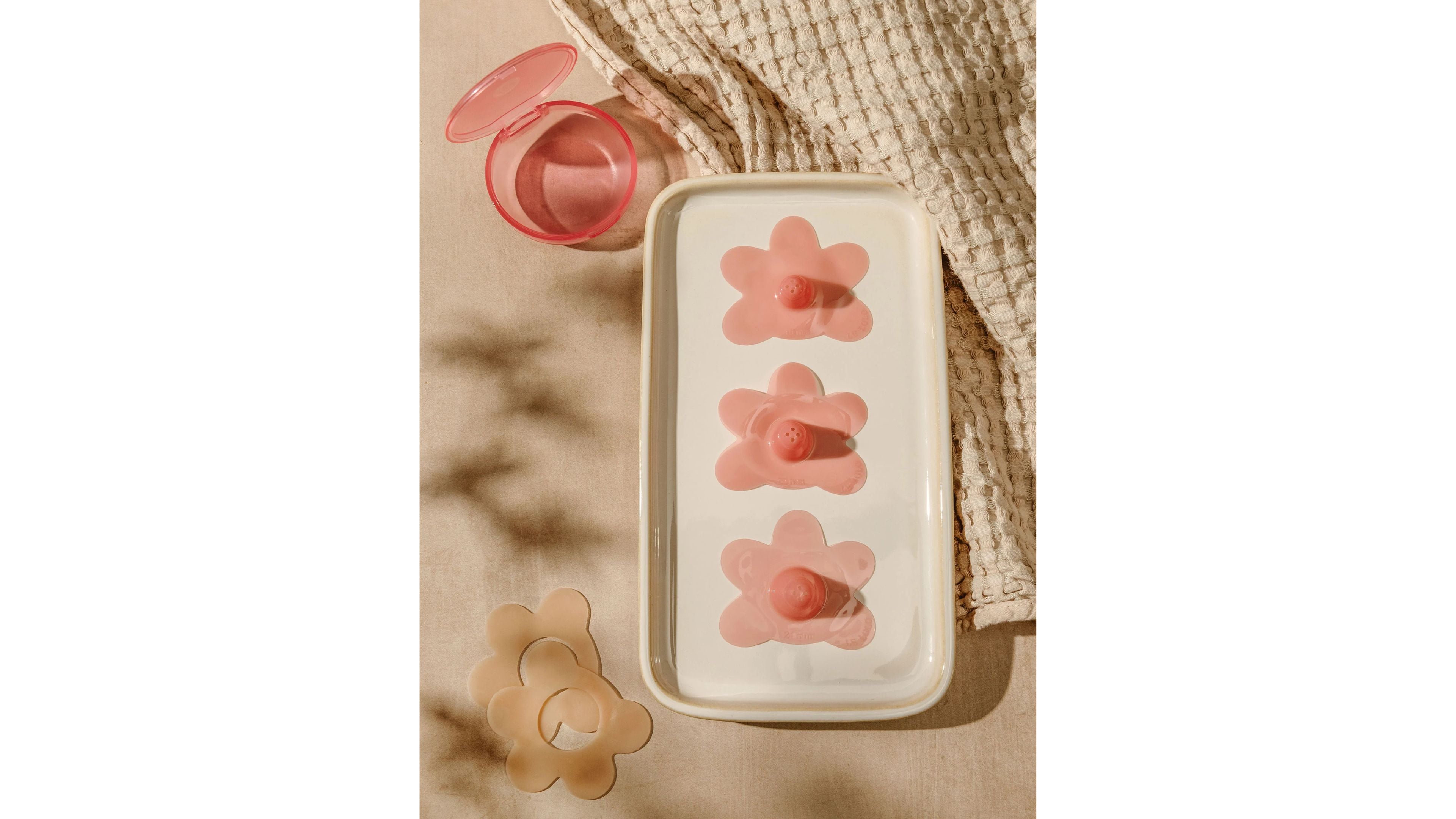 Le Lolo nipple shields
Are there different kinds of nipple shields?
Most are the same clear silicone shields you’ll see from brands like Medela, Avent, Munchkin and Lansinoh. Some parents opt for coloured shields like the ones made by Boylan's company Le Lolo, because losing a clear one in the sheets at 3 a.m. is basically a rite of passage no one asked for.
A newer variation is the Munchkin Flow Nipple Shield+, which is designed so parents can see milk moving through a channel during feeding. That visual cue may appeal to some families who want more feedback during feeds, especially when they’re feeling unsure about milk transfer. It’s still a nipple shield, not a fix on its own, but it stands out from more standard silicone shields because of that visible-flow design.
Research by the company shows that more than 90 percent of parents in a U.S. study said they met or exceeded their breastfeeding goals with it. The Flow comes in four sizes (16, 20, 24, and 28 mm), and the starter kit includes the shield, a cleaning syringe, and a compact travel case. It’s made from BPA-free silicone, designed to last for up to 200 uses, and even comes in a WIC donation program so more families can access it.

Are there any risks in using them?
Yes, if your baby isn’t transferring milk properly, they might not gain weight. One of the main concerns with nipple shields is ineffective milk transfer. If a baby seems latched but isn’t removing enough milk, they may not gain weight well, and milk supply can drop.
“Sometimes the baby ends up just being on the shield, and they don’t have much breast tissue in their mouth. If you watch them, you’re not really seeing those swallows. They may appear to be latched on, but they’re not getting a lot of milk,” says Briglio.
That can snowball into weight issues for baby and a dwindling milk supply for mom. Shields can also become habit-forming for some babies. The goal is usually to use them as a temporary tool, not forever.
How do you use them?
It would be fair to say that a deep state of sleep deprivation isn’t the ideal environment in which to teach yourself how to use a nipple shield, but that's often when it happens.
“I’ve worked with many families who are using a shield, and they had no idea how to actually put it on. You should invert the open end and place your nipple inside so that the breast tissue almost gets pulled up into the shield,” says Briglio. Meaning, don’t just pop it on like a hat.
How to use a nipple shield safely
- Start with the right size. A shield that is too small or too large can make latch and milk transfer worse, not better.
- Position your baby deeply on the breast, not just on the tip of the shield. Their lips should be flared outward on the brim.
- Watch and listen for swallowing. That matters more than whether the shield stays in place.
- Pay attention to output and weight gain. Wet diapers, dirty diapers and steady growth are all signs baby is getting enough milk.
Signs it’s working
- Feeding becomes more comfortable
- You can hear or see swallowing
- Your baby seems satisfied after feeds
- The shield doesn’t pucker or collapse during feeding
Signs it’s not working
- Feeds are still painful
- Your baby seems hungry after feeds
- You’re not hearing swallowing
- Weight gain is slow, or diaper output is low
When to get help
If your baby loses more than 10 percent of their birth weight in the first week, hasn’t regained birth weight by about two weeks, or seems to be feeding poorly, reach out promptly to your doctor, midwife, public health nurse or a lactation consultant.
Cleaning tip
Wash the shield after each use and follow the manufacturer’s instructions for sterilizing and storage.
When should you stop using them?
If your nipples heal, your baby latches like a champ, or they literally rip the shield off mid-feed, that could be a sign that it's time to stop. Some parents also start weaning off by beginning a feed with the shield, then slipping it off halfway.
While most parents think of nipple shields as tools for new breastfeeders, Boylan notes that they can also be handy with bigger babies and toddlers who are starting to bite. A nipple shield can help protect mom and extend the breastfeeding relationship (while you slowly teach your little one to stop using their teeth).

Breastfeeding should work for the whole family
If you’re stressed, in pain, or your baby isn’t thriving, it’s time to ask for help.
“Society isn’t set up to support new mothers. Lactation consultants are an uninsured service, required at a time when a mom on maternity leave has likely given up third-party insurance,” says Dr. Raimondi Dattero. So, essentially, when a new mother is most vulnerable and in need of that guidance in breastfeeding, she’s frequently left on her own, hoping the internet can show her the way.
The bottom line? A nipple shield can keep breastfeeding afloat—but it’s a lot of pressure for one little piece of silicone.
Experts
- Courtney Boylan is the founder of Le Lolo nipple shields
- Meredith Briglio is an International Board-Certified Lactation Consultant
- Dr. Christina Raimondi Dattero is a family physician and Board Certified Breastfeeding and Lactation Medicine Specialist